
By Kittredge Cherry
A queer theology of sainthood is emerging now as lesbian, gay, bisexual, and transgender (LGBT) people seek and find alternative ways to lead loving lives. Saints have been criticized as tools for enforcing conformity, but the desire for LGBT saints is springing up from the grassroots and the need is largely being met by individuals, not religious institutions. Most mainstream churches would not canonize any saints who were openly LGBT, so we must claim our own saints.
The new expressions include my own LGBT Saints series at JesusInLove.org. I have been developing a queer theology of sainthood in the process of writing more than 40 profiles of LGBTQ saints over the past two years. I had scant interest in or knowledge of the saints until a few years ago when I finished a series of books on the queer Christ (Jesus in Love novels and Art That Dares). Many people told me that they couldn’t relate to a gay Jesus, but they liked the idea that his followers were LGBT. At first I thought that LGBT saints were rare. Gradually I came to see that they are everywhere throughout all time and they are among us now. We have all met saints in our lives. They are ordinary people who are also extraordinary.
One of the greatest challenges has been to figure out who is a “saint” and who is “LGBT” or “queer.” If the boundaries of sainthood are slippery, then the definitions of LGBT and queer are even more fluid.
 |
| Saints Perpetua and Felicity by Br. Robert Lentz |
Queer has a double meaning, as defined by theologian Patrick Cheng in his book Radical Love: An Introduction to Queer Theology. It can be an umbrella term for marginalized sexualities and gender identities. But Cheng explains that the term also denotes an attitude. “In recent years, the word ‘queer’ has been used by many LGBT people as a positive label that proudly embraces all that is transgressive or opposed to societal norms, particularly with respect to sexuality and gender identity,” Cheng writes.
In light of this definition, the need for “queering the saints” becomes clear. Saints have been criticized as vehicles of the dominant morality, but for me as a lesbian Christian the opposite is true: LGBTQ saints can shake up the status quo. It’s important to re-evaluate familiar figures, to recover those who have been lost and to recognize the saints of our own time.
Churches have tried to control people by burying queer history. The LGBT saints show us not only THEIR place in history, but also OUR place because we are all saints who are meant to embody love. We can restore the complex reality of saints whose lives are being hijacked by the hierarchy to enforce the status quo. Traditional stories of the saints tend to be overly pious, presenting idealized superheroes who seem distant and irrelevant. Saints have been used to get people to passively accept oppressive situations. Too often the saints have been put on a pedestal to glorify virginity and masochistic suffering. The emphasis on miracles disrespects nature, the ongoing miracle of life. Queer saints can help reclaim the wholeness, connecting sexuality and spirituality for the good of all.
Another guiding light in my quest for queer saints has been the book Spitting at Dragons: Towards a Feminist Theology of Sainthood by Elizabeth Stuart. She is known primarily as a queer theologian, but in this book she lays a strong feminist foundation that can be applied to queer or other communities. She found that sainthood has many redeeming qualities. She writes:
“The theology of sainthood is grounded in the concept of community; it is clearly a belief system that arose from the ‘bottom up’ and was often perceived by both the hierarchy and the laity as subversive, providing another system of authority beyond and above the clerical caste, and it was a process in which women were involved from the beginning as saints, proclaimers of saints, and devotees of saints.”
Stuart’s words can apply to LGBT people as well as women. LGBT people were deeply involved in sainthood from the start as saints and as followers of saints. I apply a “hermeneutic of suspicion” as championed by feminist theologian Rosemary Radford Reuther. The dominant Christian culture tried to suppress overt homosexuality, so any hint of homosexuality that survives in the historical record should be given extra significance.
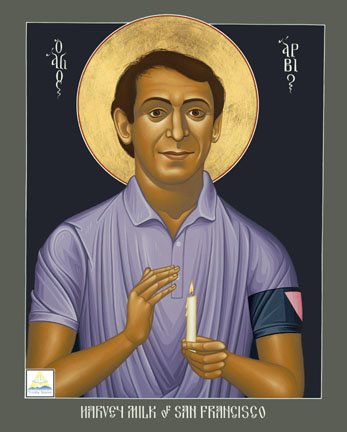 |
| Harvey Milk of San Francisco by Br. Robert Lentz |
“LGBT” and “queer” did not exist as categories throughout most of the time in which the saints lived. Many saints are said to have avoided all sexual expression, but they are still presumed heterosexual unless proven to be homosexual. Some deny the existence of historical LGBTQ saints because there is no concrete evidence of their homosexual activity. However, same-sex affection does not have to be sexually consummated for me to honor someone as an LGBT saint. They may indeed have been celibate. Deep love between two people of the same gender is enough because sexual orientation is more than sexual conduct. The American Psychological Association defines sexual orientation as "an enduring pattern of emotional, romantic, and/or sexual attractions." Many official saints were nuns or monks living in same-gender convents or monasteries. Naturally their primary emotional attachments were to people of the same gender. Soon almost all saints seem LGBT!
My definition of who qualifies as a “saint” continues to expand. First I considered saints officially canonized by the church, but I soon discovered that many have achieved “sainthood” by popular acclaim. The church didn’t even have a formal canonization process for its first 1,000 years. Ultimately all believers, living and dead, can be called “saints,” a practice that began in the early church. Yes, we are all saints!
Dictionaries define a saint as “a holy person” or “an extremely virtuous person.” I rather like the concept of sainthood that emerged in comments on my blog, the Jesus in Love Blog. Atlanta artist Trudie Barreras wrote: “My definition of saint has absolutely nothing to do with what the hierarchical church defines, and everything to do with the quality of love displayed.” Or, as gay author Toby Johnson commented, “Being a saint means creating more love in the world.”
Sainthood comes in many different forms. Some become saints by leading an exemplary life, but the surest path to sainthood is to risk or lose one’s for the good of others. As Jesus said, “Greater love has no one than this: to lay down one’s life for one’s friends” (John 15:13). Martyrs, from the Greek word for “to bear witness,” are a common type of saint.
Whether or not they died as martyrs, the lives of the saints were indeed difficult. Our lives are difficult too and that can become a point of connection. Like today’s LGBT Christians, the saints sometimes faced opposition from within the church. Some martyrs, including cross-dresser Joan of Arc, were killed not FOR the church, but BY the church!
People are drawn to the presence of spiritual power in the lives of the saints, and their willingness to use that power for others, even at great cost to themselves. The LGBT saints can inspire people to challenge unholy gender norms on our own queer paths toward sainthood.
*The images are by Brother Robert Lentz, OFM. ©
Courtesy of www.trinitystores.com (800.699.4482)https://www.trinitystores.com/affiliate/45
Courtesy of www.trinitystores.com (800.699.4482)https://www.trinitystores.com/affiliate/45
**Rev. Kittredge Cherry is a lesbian author and art historian who blogs about LGBT spirituality and the arts at the Jesus in Love Blog. Her books include Equal Rites and Art That Dares.


