Showing posts with label Jonathan Daniels. Show all posts

Friday, February 28, 2014

Remembering Trayvon Martin (February 5, 1995 – February 26, 2012)

by Diane D’Souza, Director of Lifelong Learning at EDS and The Mission Institute
A few weeks ago, in a town outside of Boston, a father opened his heart to people who thought they knew him. This father holds an important job, and you might find his wife teaching in a classroom at Harvard when she’s not in a hospital or conducting research at Tufts. They’re not expressly political, and the town they live in is a stable, wealthy, largely white one. In a church basement on a Sunday in December, this father described the moment he looked up at the TV and saw his son looking back at him in the face of Trayvon Martin. This father has two sons; one is nearing college age. As he watched the news that night nearly two years ago his mind kept flipping: Trayvon’s face, and that of his own boys, their hoodies pulled up as they came home from school.
In a room where you could hear a pin drop, the father told his white church friends something they had never heard, and something every black family has experienced or can identify with. He talked about what it’s like being a parent of a child whose skin happens to be black. He talked about the conversation he and his wife had with the boys about the police. Remember, they told them, if a police officer stops you, you could die in that moment. Move slowly; be respectful. I thought of the lessons I learned about hiking in the woods: if you hear a rattle, stop, don’t move, slowly back away. If the snake bites you make a tourniquet, make an incision at the bite marks, suck out the poison. Be prepared: this is a life threatening moment. The point is not to frighten but to prepare, to learn, to survive. For many of our black children life threatening moments are a daily occurrence---even when you’re walking home with a bag of skittles from a 7-11 grocery store.
This father spoke about the conversation he and his wife had with their eldest son about college. I’ve had that experience. It’s not always easy. It’s a bit of a tense time for our sons and daughters. Yet I’ve never had to tell my children, I’m sorry but you can’t go to a school in a state with a Stand Your Ground law. That’s non-negotiable. I love you too much, and the risk is too high. When he finished sharing and our adult forum was over, the minister of the church and other friends went up to this father to learn more about the world he and his family occupy right in their midst. They learned how well-meaning teachers and aides often stop the boys in school hallways at the end of the day, telling them to hurry so they don’t miss the METCO bus. That’s the transport run by the Metropolitan Council for Educational Opportunities which brings economically disadvantaged urban kids of color to this largely white suburban town.
We have a long way to go to move beyond our assumptions about each other. We have a long way to go drop the stereotypes which cripple and shame us. We have a long way to go to name the privilege that allows parents like me to take my children’s safety for granted---even if it is an illusion. We have a long way to go to create the beloved community that was part of Dr. Martin Luther King’s dream. There is much unfinished work.
I am grateful to live in a world where the Dream Defenders, the “sons and daughters of slaves and farm-workers… a generation of world changers, writers, readers, rebels, marchers, dreamers, leaders, thinkers, organizers, activists and revolutionaries” remind us that we are all complicit in the death of Trayvon Martin. These young leaders remind us that real change begins right here and now: by finding the humanity in each other; by questioning our truths; by having real conversations with ourselves, with friends, with strangers; by channeling our anger, our confusion, our angst into a burning passion for positive action. We need the energy and vision of the young, the wisdom and experience of the old, the perspectives of those different from ourselves, and the gift and hard work of shedding our assumptions. Only then, through a re-energized commitment to bettering ourselves and the societies we create, do we truly honor the life of Trayvon Martin.

Tuesday, August 20, 2013

A Pilgrimage to the Holy Land: Reflections on the 2013 Jonathan Daniels and All Martyrs Pilgrimage

Jonathan Daniels Pilgrimage 2013
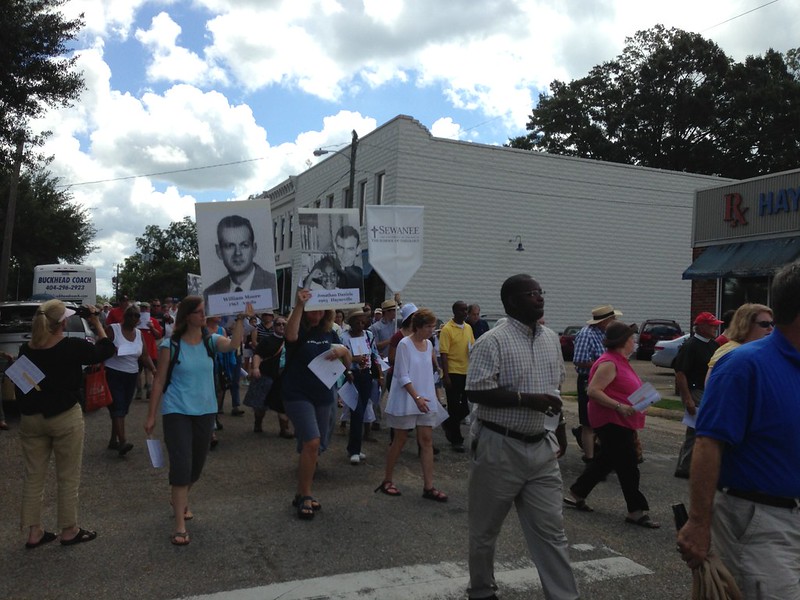
The 2013 Jonathan Daniels and All Martyrs Pilgrimage in Hayneville, Alabama (from the EDS Flickr page)

by Diane D'Souza, PhD, Director of Lifelong Learning @ EDS

There is something about walking and traveling together which touches my soul. I’m not talking about getting on a bus or airplane and moving from point A to point B. I mean the act of journeying together: having a purpose or mission; a time to listen, talk, and reflect with others; and an opportunity to share the unanticipated bends and twists of the journey. People have known this for centuries: whether it is Hindus coming to bathe in the sacred river for the Kumbh Mela, Muslims uniting for the Hajj on the plains of Arafat in Mecca, or the Ngarrindjeri and other indigenous peoples dancing the spirit back into the Murray Darling River in the South Australian Ringbalin. Christians, too, have a history of sacred traveling: to sites important in Jesus’ life, and to places associated with saints inspired by him.

Last week I joined a small Episcopal Divinity School (EDS) delegation for the annual Jonathan Daniels and All Martyrs Pilgrimage to the Holy Land. That’s how Bishop Rob Wright of the Diocese of Atlanta, and fellow pilgrim, refers to the American South. The pilgrimage, which wound its way from Atlanta to Alabama, traced a portion of our nation’s civil rights history, and honored Alabama martyrs of that movement, including Jonathan Daniels, a man whose name I didn’t even know before I started working at EDS.

Jon Daniels was a former EDS (then, Episcopal Theological Seminary) student who, like his Cambridge peers, was stunned by the 1965 death of Jimmie Lee Jackson and the subsequent Bloody Sunday clash. Together with many of his fellow seminarians, he answered the call of Martin Luther King Jr. and traveled to Alabama to join the civil rights response. When his classmates returned to Cambridge, Jon along with Judith Upham convinced school authorities to let them spend the rest of the semester in and around Selma, helping to register African American voters, and to assist with the struggle to desegregate churches and businesses.

Despite some threats, and against the caution of his mother and others, Jon made the decision to continue to stay in Selma for the summer. He found the work meaningful and important, and felt at home in the family of Alice and Lonzy West, activists in the voter registration movement. Their generous hospitality, which they extended at some risk to their family, was an important source of strength. When Jon voiced his frustration and shame that the local church would not welcome the black youngsters who went with him to attend weekly worship, he was comforted and encouraged by who had long experience with this type of oppression. Jon’s strong, intimate relationships with African Americans in Selma like the Wests fueled his resolve to continue working for equality among all our nation’s citizens.

But, in a turn all too familiar in stories of the Civil Rights Era, Jon’s work for peace and justice was met with violence and hate. On August 20, 1965, Jonathan Daniels was shot and killed by Tom Coleman, a highway department engineer and unpaid special deputy. Coleman also shot and severely wounded Richard Morrisroe, then a Catholic priest. The details of the story are dramatic and tragic but, as EDS student and fellow pilgrim Angie Hall pointed out while we traveled together, they were not so unusual for blacks in the South, who had been terrorized and killed with impunity for decades. Author and historian Charles Eagles aptly notes that Coleman used his shotgun to radically defend the local way of life against “outside agitators.”

I witnessed and learned many things as a pilgrim. I climbed the stairs of the Ebenezer Baptist Church in Atlanta and was startled by my grief at seeing a photograph of a young, vibrant Martin Luther King Jr. Hearing his voice ring out over the pews where he preached for so long, I could only feel the profound loss we have endured in our struggle for Civil Rights. At the Clark Atlanta University Art Galleries, I was dumbfounded how racism could have blinded people to the stunning works of African American artists, and grateful to Hale Woodruff and Atlanta University for having the courage and foresight in 1942 to offer annual exhibition opportunities to artists of color whose ability to show their art was limited by segregation.
Time slowed down for me in Hayneville, Alabama, where Jonathan died and the Episcopal Diocese of Alabama and its partners hold this annual memorial pilgrimage to mark the deaths of all Alabama civil rights martyrs. The pilgrimage around the town proceeds in a “stations of the cross” style. It starts in the town square; moves to the jail where Jonathan, Stokely Carmicheal, and two dozen other young civil rights workers were imprisoned; then pushes on to the storefront where Jonathan was killed; and finally to the courthouse where Tom Coleman was acquitted of Jonathan’s murder. It is a powerful circuit to make with three hundred people of all colors and ages. I have no words to convey the moments when a young man sang the negro spiritual, “Soon I Will Be Done with the Troubles of the World” while many of the pilgrims came forward to touch or kiss the stair on which Jonathan died. Nor to describe one of the most moving moments of this well constructed liturgy, when volunteers brought to the front of a packed courtroom placards bearing the faces and names of each of the fourteen Alabama civil rights martyrs being honored. The calling of each individual name and the volunteer’s response, “Present!” which preceded the telling of each story, was a moving testament to loss, courage, and the bloody history of our continuing journey to dismantle racism. Seeing Bishops Rob Wright and Santosh Marray, both men of color, celebrating the Eucharist on the very courtroom bench where justice was so ill-served forty-eight years ago, brought perspective, and buoyed my hope.

I know I will write more about the pilgrimage, for there is much which is still settling in my soul. Meanwhile, I am energized by the thought of the 2014 event (Aug. 6-10) which we have started planning in collaboration with other dioceses and partners around the country, and the fiftieth anniversary celebration in 2015 which Jonathan’s classmates, the EDS alumni/ae of 1965, ’66, and ’67, are already calling a long-awaited reunion.

If you are interested in participating in or helping to organize the EDS delegation to the 2014 Jonathan Daniels Pilgrimage, please contact Diane D'Souza at lifelonglearning@eds.edu or call 617-682-1505.