Thursday, May 31, 2012

Dispatch from China: Roman Catholic Redux


By Gale A. Yee

The Dushu Lake Church in Suzhou was our next destination in our fully packed schedule. We entered a spacious industrial park of manicured open spaces and a huge stone bust of Albert Einstein with his famous E=MC squared formula nestled beside it. A church here, in this strange locale? We spent a while looking for this church until we saw a steeple peeking out incongruously amid the modern sleek buildings.

Our bus was too large to enter the grounds, so we took off on foot. We walked to a very large pond of water lilies, surrounded by a wooden ramp which was our scenic route to the church. At the top of a set of stairs was a big bronze statue of Jesus with arms outstretched.  Something was vaguely familiar about this Jesus. Smack dab in the middle of his chest was this large heart. A statue of the Sacred Heart of Jesus in this post-denominational church! 

As a former Roman Catholic, I often thought Protestant churches very spare. But here was a church with a Sacred Heart and beautiful stained glass windows of Old and New Testament bible stories. Stained glass windows were even in the lavatories. The women's room depicted Noah's ark. I had a chuckle when told that window in the men's bathroom was the expulsion from the Garden of Eden.

I was fascinated by these windows because I use a lot of art in my PowerPoint slides for my Introduction to Hebrew Bible and New Testament courses. Depicted in the church were the Garden of Eden, the temptation of Eve, the sacrifice of Isaac, Joseph interpreting Pharaoh's dreams, among many others. I noticed that these windows in the main church depicted the Bible characters as Westerners. However, the art in the basement of the church were by the Chinese artist He Qi, a former professor at Nanjing Theological Seminary. What a contrast! He Qi uses vibrant primary colors for his paintings. His Bible characters have stylized Asian features and were dressed in Asian costumes. My favorite windows were those of the crossing of the Red Sea and of Moses giving the Ten Commandments. Moses looks likes a stern Manchu emperor as he holds up the stone tablets.

Because the church served a highly educated intellectual congregation, it was important for the church to incorporate beautiful artwork in its construction. Each Sunday there are two services. The first is for the Chinese speaking community. One thousand people fill the main church and two chapels. The second service at 10:30am is English-speaking with about 350 attending from over 20 different countries. A pastor named Fr. Tom services this English congregation.

As I left the church I gazed again at the Sacred Heart and compared this Western Christ with He Qi's Jesus with his almond eyes, broad nose, and darkened skin. I prayed for more Asian Christian artists to come forth from the Chinese church to produce their own distinctive Asian Jesus!

Dr. Gale A. Yee is Nancy W. King Professor of Biblical Studies at Episcopal Divinity School. 


Wednesday, May 30, 2012

Dispatch from China: Marco Polo and the Silk Road


By Judith Nies

In my early morning walk around the beautiful West Lake in Hangzhou, I was surprised to see a statue of Marco Polo.  (I was also surprised to see Pui Lan there at 6:30 in the morning.)

In his book about his fifteen years in China (The Travels of MarcoPolo), he called Hangzhou "the most beautiful city in the world," with its fine markets and beautiful gardens.  In fact in the 13th century China was far more advanced that medieval Europe.  Although we think of Marco Polo as a great traveler and explorer, he was also looking for new technologies and products. He and his father and brother were Venetian traders who followed the Silk Road into China, (the name for several ancient trading routes that ran from eastern Europe to Xi'an in western China).

Until our EDS group visited the Silk Factory in Suzhou (a city about thirty miles away from Hangzhou), I never realized how amazing it was that he was able to transfer silk technology back to Italy. It involved taking living silkmoths, mulberry trees, and the techniques of spinning the moth’s cocoons into silk thread and then weaving it into a silk textile. Today, the town of Como (roughly sixty miles west of Venice) is the center of the European silk industry. 

Italians tell you that Marco Polo chose it because it had a similar microclimate as Suzhou for growing the Mulberry bushes and keeping the moths alive. How he managed to keep everything alive on the journey back is a great mystery. (The moths live only 25 days.) Cross-cultural exchange from China began very early.

Hangzhou may also have something to teach us today. At 6:30 in the morning the lakeside was buzzing with people walking and doing early morning exercises that included ballroom dancing, Tai Chi, Tai Chi with swords, and other exercises I don’t know the names of. But they were stretching and doing exercises that counteract all the backpains and shoulder aches that we Americans complain of.

Judith Nies is grants manager at Episcopal Divinity School. 

Tuesday, May 29, 2012

Dispatch from China: Megachurch in China


By Barbara Elliott

Members of the China travel seminar of the Episcopal Divinity School visited the Chong Yi Church, a megachurch in Hangzhou on May 23. We visited with the assistant pastor and an elder, whose English was good. The elder completed his master of divinity degree last year and is in the ordination process, which will take two more years.

The Protestant church in China is post-denominational, meaning there are no denominations among the Protestant churches. This continues to be a work in progress, as described by the seminary administrators who are teaching future church leaders. In the seminaries, the range of denominational approaches is introduced to the students who have each brought their own traditions from their home churches, as well. We have been visiting and worshipping in a number of church settings and have seen the range of fundamental, evangelical, and more progressive church experiences.

Chong Yi Church was completed in 2005 with 2,000 members; now it has 3,000 attending the early Sunday service with traditional music and 7,000 attending the second service, which incorporates modern music. There are 1,500 volunteers who provide leadership for their ministries, which include pastoral care, mission or evangelizing, care groups to shepherd others, and Bible training. The Sunday school serves 1,000 children and youth each week in 20 classes with 100 teachers.

At Chong Yi Church, the Bible is the basis for the preaching, and it seems to be followed quite literally. When we asked about social justice and lesbian, gay, bisexual, transgender, and queer issues, our hosts paused, and then responded by saying that the Bible said homosexuality is a sin. We observed that the Great Commandment (which is engraved and printed on all their materials) calls us to inclusive welcome, but they only reiterated their position. Further discussion also revealed that the church taught that couples should be loyal to one another, and men and women who have cohabited before marriage cannot be married in the church. When we asked, our hosts did not describe having any programming for those who are immigrating into the community, living in poverty or homeless, or struggling with other justice issues.

Our hosts explained they are a “baby church”—newly organized and currently focused on expanding their membership. This process seems to be quite successful. The church has eight evangelical events each year, with musicians, video, choirs, and preaching introducing Christianity and their community. In the past few years, they have reached thousands people this way. For those who are interested, disciple training follows before baptism. This process has helped to grow the church to its current size and also resulted in a second church being built to serve a comparable number of new Christians.

Megachurches in China resemble those in other places around the world!


Barbara Elliott, MDiv ’12, is a professor in the Department of Family Medicine and Community Health at the University of Minnesota, Duluth campus.

Friday, May 25, 2012

Dispatch from China: Phenomenal Church Growth


By Kwok Pui Lan

China has enjoyed phenomenal church growth in the last few decades. For some this is quite unexpected, considering that China is a Communist country. When the People’s Republic of China was founded in 1949, there were about 700,000 Protestant Christians. Today, the number is about 23 million. If we include members of the house churches (or underground churches), the number is somewhere between 50 to 80 million.

Members of our travel seminar to China have had first-hand experiences of this unprecedented growth when we visited three churches in three cities in the last few days. In Shanghai we attended church service in the Shanghai Community Church. The main sanctuary was filled half an hour earlier before the service started at 10 am. There were four additional rooms filled with people watching the service on closed circuit TV. We worshipped with about 2,000 people on Ascension Sunday on May 20.

In Hangzhou, we visited Chong Yi Church, the largest church in China, which can seat 7,000 people. The Church has 5 pastors, several elders, and a large team of lay leaders serving a congregation of 6,000 members and a Sunday school of 1,000 children. The service on Sunday with modern church music is always filled to capacity.

The pastor attributed this enormous growth of the church to the grace and blessings of God, the committed and collaborative leadership of the pastors and lay leaders, and the witness of church members in their families, workplaces, and society.

We had the opportunity to visit a very new church located in the Suzhou Industrial Park. This industrial park was built 18 years ago as a center for higher education and research. Some 20 colleges and universities are located in the vicinity. The Dushu Lake Church, with a magnificent Gothic architectural design featuring pointed arch, ribbed vault, and flying buttress, was completed in 2010. It has three pastors, including a female associate pastor, and a congregation of 700. We were all taken by the scale of the church, and especially by the beauty of stained-glass windows with both European and Chinese designs. It is a 39-million-yuan (US 6.3 million) project.

This new church is the only church in China with bilingual services. In additional to the Chinese congregation, an English-speaking congregation with members from over 20 nationalities shares the space. The English-speaking congregation is served by a priest from the United States, and the two congregations worshipped together last Easter.

I have visited churches on China in a number of occasions. My first visit dated back to the mid-1980s, when the churches had only been re-opened for several years. I can discern several changes in the Chinese churches in last few decades. When I first came to visit the churches, the majority of the Christians were middle-aged and elderly people, since the churches were closed for ten years during the Cultural Revolution (1966-76), and there were not many new members. The pastors were middle-aged or older in the 1980s as they had been ordained before the Cultural Revolution.

But in the Chinese churches today, there are many young people. In the intervening years, the seminaries in China have trained a new generation of church leaders and faculties of seminaries. There are currently 21 seminaries and Bible schools. We visited the regional East China Theological Seminary, which was established in 1985. The seminary has 17 full-time faculty and 50 part-time teachers, and about 200 students studying for a four-year bachelor diploma, a part-time two-year program, and a sacred music program. The school has graduated over 1,000 graduates serving in the churches.

Another significant development is the provision of social services by some of the churches. Back in the 1980s, the focus was on rebuilding the church. Now the churches are more established and they can provide services to help the poor and can provide relief during a natural disaster, especially during the 2008 earthquake. The Dushu Lake Church organized a church bazaar, and people could bring old and new items to be sold. The money raised went to support poor students. These kinds of activities aim to heighten environmental consciousness of members. Some churches offer evening worship services and other services for the migrant workers, who have come from the rural areas to work in the cities.

Since the three cities we have visited—Shanghai, Hangzhou, and Suzhou—are rich compared to other Chinese cities and have long cultural history, the churches we have seen have a middle-class outlook—classical and modern music, team of seminary-trained pastors, and bookstore selling Christian literature and artifacts in the churches. The churches serve a new generation of people born in the 1980s and 1990s, who have grown up during the rapid economic development of China in the last several decades. The Dushu Lake Church serves an intellectual and multinational community.

I wonder what kind of theological construction is being done to meet the challenges of this new China. A young man we met at Dushu Lake Church was a tourist from Shenzhen, who wore a Celtic T-shirt, and told us he loves Paul Pierce and watches the NBA on Chinese TV. I look forward to the conversation with theological educators to understand how they are preparing young women and men (most seminaries are young people pursuing their bachelor diplomas) to serve this increasingly diverse and globally–conscious Chinese society.


Kwok Pui Lan is the William F. Cole Professor of Christian Theology and Spirituality at the Episcopal Divinity School and her most recent book is Globalization, Gender, and Peacebuilding: The Future of Interfaith Dialogue. 

Wednesday, May 23, 2012

Dispatch from China: A Chinese-(Ugly) American's Adventure in China


By Dr. Gale A. Yee

After we arrived in Shanghai, I developed a sore throat, which is always my warning sign for future bronchial problems. Touring the markets after our lunch, I searched in vain for a drug store for throat lozenges. When I returned to the hotel, I asked one of the attendants for the nearest drug store. I told him I had a sore throat. His English was minimal, but he told me that he only knew of a Chinese medicine store. He wrote something in Chinese, saying this is what you want for the throat, and wrote in English the name of the store: Tong Han Chun Tang. At least that's what I thought! For directions, he told me to go this way and that and then turn right at the McDonalds, which fortunately I knew.

So I turned right at the McDonalds and walked several blocks looking for Tong Han Chun Tang. Of course, there were no English store names, but I saw a sign with a green cross, and thought that it might be the equivalent of our Red Cross. There were women dressed in white uniforms and I thought, Nurses! I showed them my little piece of paper which I thought was my sore throat medicine. They sent me upstairs where there were more women in white. I showed them my little piece of paper, and they pointed me to another woman in white, who looked at me blankly when I gave her my little paper. I finally clued in that the Chinese writing was simply the name of the store and not the medicine.

So, to communicate what I needed I pointed to my throat and made some sort of gurgling sound. She pulled out two packages, wrote out a note and sent me to another woman in white to pay for the medicine. One contained a bottle of liquid and the other tablets, which I hoped were my throat lozenges.

I thought I'd better have Pui Lan check out these medicines. She didn't quite know what they were either, but she said I take 20 ml of the liquid 3x a day, and four of the tablets 4x a day with water. I'm sure glad I checked with Pui Lan first before I sucked on those tabs!

I am happy to say that the medicine seemed to work, or perhaps I am just glad that I wasn't given medicine for in-grown toenails.

Dr. Gale A. Yee is Nancy W. King Professor of Biblical Studies at Episcopal Divinity School. 

Tuesday, May 22, 2012

Dispatch from China: The Food of Shanghai


By Catherine Owens

EDS China Travel Seminar eating in Shanghai
In the best EDS tradition of both/and, this trip to China is a feast for the body as well as the spirit. I should tell you that when I was accepted to this travel seminar, the first thing I researched was the cuisine of the various areas we were going to visit. I had hoped that I might, if I was lucky, get to taste one or two foods I read about. I did not expect that, by the end of our first full day here in Shanghai, I would have tasted so many of them.

In any other trip I’ve taken, the hotel breakfast alone would be worth a whole blog post. But for this trip, I will only say that if you imagine any breakfast you’ve ever eaten in any country, you could probably find it at this breakfast—I can’t even call it a buffet, more like 14 buffets. We were always looking at each others’ plates and saying, “Where did you get that?” to which my favorite response was “Over by the sushi!”

After church we came back and changed into tourist clothes, and our guide walked us over to Shanghai Old Town, an area that combines flea markets that are essentially wholesalers to other local vendors with stores for the tourist trade. These are mostly in “new” Shanghai Old Town, where all the buildings look like what you might imagine Chinese buildings from the 18th century would look like. Our guide pointed out a variety of US chain restaurants, but a number of us clamored for local cuisine.

The hard part about travelling in packs of ten or more is that most small local restaurants aren’t set up to handle groups that big (whereas Hilary Allen and TJ Tetzlaff went into a small place and ended up eating in the owner’s kitchen!). Someone standing next to us told us we should eat dumplings. “Yes, dumplings!” we cried. So our guide took us to the Nan Xiang Dumpling House, one of the best-known Shanghai dumpling houses. When we got there we were faced by a line of, I swear, at least 100 people waiting for dumplings. This was, thanks be to God, the take-out line—we were going upstairs to the restaurant proper, where, after only a short wait, we got a table that the 11 of us were able to squeeze around and bought what was effectively a dumpling tasting menu.

One of the Shanghai specialties I’d read about was the xiaolongbao or soup dumpling. These are made by taking thin wheat-based dumpling dough (think potsticker dough, only less dense), forming it into a pouch, filling it with soup, and steaming it. I had read that you bit a hole in the dumpling, slurped out some of the soup, and then ate the dumpling dough with the rest of the soup. One of our dumplings was clearly recognizable as a soup dumpling. It sat in its own little teacup-sized bamboo steamer, and poking out of the top of it was a red and white striped plastic straw, handily placed for soup slurping. The soup was a crab broth, and it was delicious. Little did we know that soup dumplings lurked under other guises. I bit into what was obviously a fried shrimp ball and showered Herb Sprouse with soup. We got steamers of what were clearly shui mai—only they weren’t, they were little soup dumplings, filled not only with soup but also with a meatball. We had soup all over the table with that round. At dinner Sunday night, the coordinator of our trip from the China Christian Council demonstrated how to eat these, warning us to be very careful because the soup inside was extremely hot. I felt the scorched roof of my mouth with my tongue and nodded sagely in agreement.

Which brings me to Sunday night’s dinner, at the Lu Bo Lang restaurant, in new Shanghai Old Town across the square from the soup dumpling place. Over 100 years old, this is one of the ten best restaurants in China, specializes in Shanghai-style cuisine, and has served a whole range of dignitaries over the years, including Bill Clinton. We had a private dining room with two round tables and a Lazy Susan in the center of each. And we were served what may well be the best meal I have ever had. There was the variety—20 dishes (yes, 20!). There was the presentation—a dish of baby bok choy about the size of my thumb, steamed perfectly to a brilliant green, and arranged in a beautifully symmetrical wreath with a crab sauce in the center. And a “river fish” that had been sliced almost all the way through, then battered and fried, then sauced with a sweet/hot red chili sauce. Served with the head and the tail and the red sauce, it looked like a dragon. And there was the orchestrated progression, from cold dishes to soup and lighter seafood and vegetable dishes, to heavier dishes like dressed duck and braised buffalo with vegetables, then moving to lighter, sweeter dishes like a sweet gelatinous rice cake, and ending with fruit. We were told that only when we see the fruit being served do we know that a banquet is over.

Some of the dishes were challenging—not everyone ate the cold marinated jellyfish, for example. And the hot duck dish, eight treasure duck, came with a rice dressing. I among others assumed that the focus of the dish was the duck, only to learn that the focus of the dish was the rice—the duck was mostly there to flavor it. These meals have been only one of the many ways we have revealed our ignorance, been blessed by the kindness of those around us, and had our cultural assumptions turned upside down. A feast for the mind and spirit indeed!

P.S. On Monday at lunch we were treated to yet another Shanghai-style feast. I now know that the number of dishes, the progression, and even the kind of dish is consistent. It too started with eight cold dishes, it too included jellyfish, it too had a baby bok choy wreath, but it was filled with sea cucumber (my first!) instead of crab, the whole fish was done in a casserole instead of looking like a dragon, and so on. It too was delicious, and most of us enjoyed it a great deal, but tonight a number of us went for very simple food in very small quantities.

Members of EDS faculty and staff in Cambridge on Monday
in solidarity with the EDS China Travel Seminar. 
[Editor's Note: In solidarity with the EDS China Travel Seminar, a group of faculty and staff went out to our local Chinese restaurant in Cambridge, Massachusetts for a buffet lunch on Monday afternoon. See photo right.] 

Catherine Owens is a student in the MDiv program at EDS. She loves learning about a culture through the lens of what the people eat.  

Monday, May 21, 2012

Dispatch from China: Homecoming


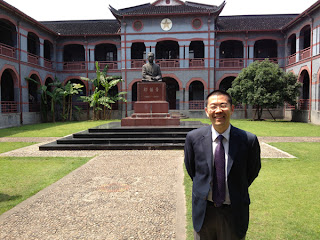
Professor Patrick S. Cheng at the former campus of
St. John's University.
By The Rev. Dr. Patrick S. Cheng

I had a powerful homecoming experience in Shanghai on Monday afternoon when the EDS China travel seminar visited the former campus of St. John's University.  During that visit, I made a connection with my late father and his beloved alma mater in a way that I had never expected.

St. John's was a university founded in 1879 by the missionary bishops of the Episcopal Church in China.  In its heyday, St. John's was one of the most prominent universities in China, and many political and economic leaders during the first half of the 20th century were graduates of that institution.  St. John's was closed in 1952, and today its former campus houses the East China University of Political Science and Law.

My dad, who passed away in 2007, was a proud alumnus of the St. John's University class of 1946.  In general, he never talked a lot with my brother or me about his childhood growing up in China.  I suspect that was due in part to the trauma of fleeing from Shanghai to Hong Kong in the late 1940s.  After leaving China, he lost contact with his family in mainland China for decades and never saw some of them again.

My dad did, however, speak fondly about St. John's University.  He would talk about his dorm life and how he was one of their star soccer players.  Our family would attend periodic reunions of the St. John's alumni in the San Francisco Bay Area at Grace Cathedral in downtown San Francisco.  And my dad's diploma from St. John's -- which included a vintage black and white photo of him affixed to the document -- always hung proudly over his desk at home.

I regret that I never had more of a chance to talk with my dad about his life growing up in China.  He died before I finished my PhD, and he never saw me become a theologian or join the faculty of EDS.  But as I stood in the middle of the courtyard of the former Schereschewsky Hall on Monday afternoon, I couldn't help but feel his presence on that campus over 65 years ago.  And I was very moved when all of my EDS colleagues took a moment to honor his memory and recognize what that moment meant to me.

My dad's diploma still hangs on the wall of his former study in my mom's house.  St. John's University no longer exists, and my dad is no longer with us.  But thanks to the EDS China travel seminar, I was able to make a powerful connection with both my dad and St. John's on Monday afternoon.  I was transformed by my homecoming experience in Shanghai, and for that I am grateful.

The Rev. Dr. Patrick S. Cheng is the Assistant Professor of Historical and Systematic Theology at Episcopal Divinity School.